 English
 Arabic
 French
 Spanish
 Portuguese
 Deutsch
 Turkish
 Dutch
Dutch
 Italiano
 Russian
 Romaian
 Portuguese (Brazil)
 Greek
Greek
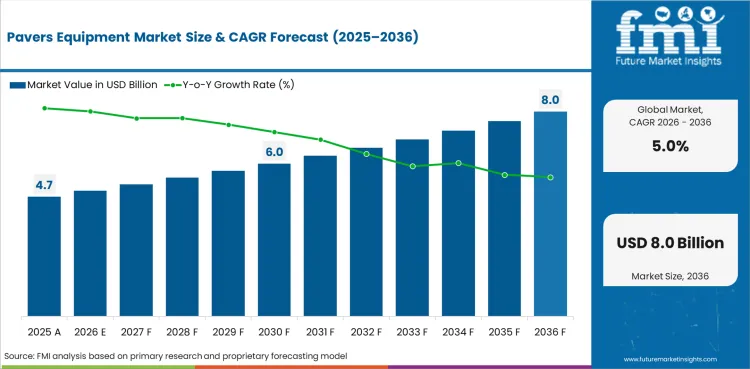
the global Pavers Equipment Market is entering a period of sustained growth as governments, contractors, and infrastructure developers increase investments in road networks, urban mobility projects, airports, and logistics infrastructure. According to Future Market Insights (FMI), the market is projected to grow from USD 4.9 billion in 2026 to USD 8.0 billion by 2036, registering a CAGR of 5.0% during the forecast period.
The increasing emphasis on high-quality road construction, sustainability-led procurement, and automation-enabled construction practices is transforming the paving equipment landscape. Modern pavers are becoming smarter, more efficient, and environmentally compliant, helping contractors improve productivity while reducing operational costs and environmental impact.
Get detailed market forecasts, competitive benchmarking, and pricing trends: https://www.futuremarketinsights.com/reports/sample/rep-gb-22865
Key Market Insights
- Market Size (2026): USD 4.9 Billion
- Forecast Value (2036): USD 8.0 Billion
- CAGR (2026–2036):0%
- Leading Equipment Segment: Asphalt Pavers (46.3% Market Share)
- Dominant Paving Width: 5 to 10 Meters (51.8% Market Share)
- Top Growth Markets: China and India
- Key Drivers: Infrastructure modernization, sustainability mandates, automation, and smart construction technologies
Market Overview: Infrastructure Development Fuels Equipment Demand
The pavers equipment market is benefiting from an unprecedented wave of infrastructure development worldwide. Governments are allocating substantial budgets toward highway expansion, road rehabilitation, smart city initiatives, industrial corridors, and airport modernization projects.
As construction projects become increasingly complex, contractors are seeking advanced paving equipment capable of delivering higher accuracy, superior surface quality, and faster project completion. This demand is accelerating the adoption of technologically advanced pavers equipped with intelligent controls, automated leveling systems, and real-time monitoring capabilities.
The market is also witnessing growing demand from emerging economies where rapid urbanization and industrial development continue to drive transportation infrastructure investments.
Key Market Drivers
- Expanding Global Infrastructure Investments
Large-scale public infrastructure projects remain the primary growth engine for the market. Investments in highways, bridges, airports, and logistics corridors are creating consistent demand for advanced paving equipment across developed and developing economies.
- Sustainability-Led Procurement Strategies
Environmental regulations and sustainability goals are influencing equipment purchasing decisions. Contractors increasingly prefer fuel-efficient machines that reduce emissions, optimize material usage, and support environmentally responsible construction practices.
- Automation and Digital Construction Technologies
The construction industry is rapidly embracing automation through:
- GPS-guided paving systems
- Automated grade and slope controls
- Telematics-enabled fleet management
- Predictive maintenance solutions
- Real-time performance analytics
These technologies improve paving accuracy, reduce downtime, and enhance operational efficiency.
Regional Insights
China Leads Global Growth
China is expected to emerge as the fastest-growing market, expanding at a CAGR of 6.8% through 2036. Strong government spending on transportation infrastructure, urban development projects, and industrial expansion continues to drive demand for advanced paving machinery.
India Maintains Strong Momentum
India is projected to grow at 6.3% CAGR, supported by large-scale highway development programs, smart city initiatives, and expanding industrial infrastructure. Government-led investments in connectivity projects are creating significant opportunities for equipment manufacturers.
Europe Focuses on Sustainable Infrastructure
Germany and France continue to witness stable growth due to stringent environmental regulations, infrastructure modernization programs, and the adoption of energy-efficient construction equipment.
United States Benefits from Infrastructure Renewal
The U.S. market is expected to maintain steady growth, supported by road rehabilitation projects, transportation upgrades, and growing investments in logistics and warehousing infrastructure.
Technology Trends Reshaping the Market
The next generation of pavers equipment is increasingly characterized by digitalization and automation. Key trends include:
- AI-assisted paving optimization
- Intelligent compaction systems
- Machine control and automation technologies
- Digital fleet monitoring platforms
- Hybrid and fuel-efficient equipment
- Remote diagnostics and predictive maintenance
These innovations are helping contractors maximize productivity while ensuring compliance with evolving environmental and operational standards.
Segment Insights
Asphalt Pavers Continue to Dominate
Asphalt pavers are expected to account for 46.3% of total market revenue in 2026. Their widespread use in highway construction, urban roads, and commercial infrastructure projects makes them the preferred choice for contractors worldwide.
5 to 10 Meter Paving Width Leads Demand
The 5 to 10 meters paving width segment is projected to hold 51.8% market share, driven by its versatility across medium- and large-scale infrastructure projects. The segment offers an optimal balance between productivity, maneuverability, and cost efficiency.
Challenges Facing the Market
Despite positive growth prospects, the industry faces several challenges:
- High capital investment requirements
- Fluctuating raw material costs
- Skilled labor shortages
- Equipment maintenance complexities
- Increasing compliance requirements
Manufacturers must continue investing in innovation and service capabilities to address these challenges effectively.
Competitive Landscape
The global pavers equipment market remains highly competitive, with leading manufacturers focusing on product innovation, automation, sustainability, and geographic expansion.
Key Companies
- Caterpillar Inc.
- Volvo Construction Equipment
- Wirtgen Group
- BOMAG GmbH
- SANY Group
- Terex Corporation
- Astec Industries, Inc.
These companies are strengthening their market positions through advanced product development, strategic partnerships, and investments in smart construction technologies.
