 English
 Arabic
 French
 Spanish
 Portuguese
 Deutsch
 Turkish
 Dutch
Dutch
 Italiano
 Russian
 Romaian
 Portuguese (Brazil)
 Greek
Greek
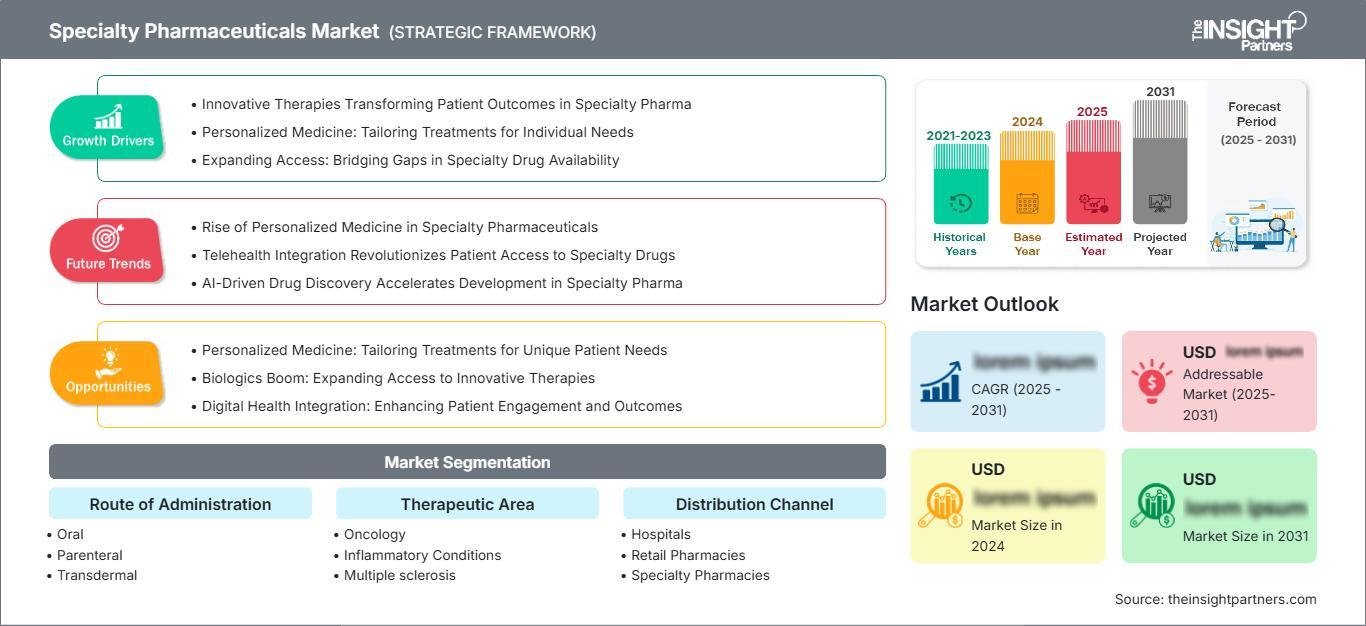
The North America specialty pharmaceuticals market is entering a high-velocity phase of expansion, driven by a sophisticated healthcare infrastructure and an intensifying focus on high-cost, high-impact therapies. As of 2026, North America maintains its position as the global leader in this sector, accounting for nearly 48% of the total market share. This dominance is supported by the region's rapid adoption of biologics and a regulatory environment that prioritizes the fast-tracking of innovative treatments for complex diseases.
Market data for 2026 indicates that the North America specialty pharmaceuticals market is valued at approximately USD 410.5 billion and is projected to surpass USD 720.8 billion by 2032. This growth reflects a robust CAGR of 9.8% over the forecast period. The region's market dynamics are uniquely shaped by the high per-capita healthcare spending in the United States and Canada, where specialty drugs now represent over 50% of the total pharmaceutical spend, despite accounting for a small fraction of overall prescription volume.
Download Sample Report - https://www.theinsightpartners.com/sample/TIPRE00021699
Core Drivers of the Specialty Pharmaceuticals Market Dynamic
The in North America is currently influenced by several pivotal factors that are accelerating revenue and patient access:
1. Dominance of Oncology and Rare Disease Therapies Oncology remains the primary therapeutic driver in North America, representing roughly 47% of all specialty drug spending. The launch of next-generation immunotherapies and antibody-drug conjugates (ADCs) has created a high-value market segment that continues to grow. Additionally, the FDA’s continued use of Orphan Drug Designations has led to a surge in treatments for rare genetic disorders, which often command premium pricing due to their life-saving nature.
2. The Accelerating Biosimilar Wave A critical shift in the is the widespread adoption of biosimilars. With the patent expiration of several "blockbuster" biologics by 2026, the North American market has seen a record number of biosimilar launches. This competition is helping to manage overall costs while simultaneously expanding the volume of patients who can access advanced biologic treatments.
3. Integration of AI in Drug Development and Patient Care North American pharmaceutical leaders are aggressively embedding artificial intelligence into their R&D pipelines. In 2026, AI-driven discovery is credited with reducing the time-to-market for specialty molecules by nearly 30%. Furthermore, digital health tools and telepharmacy platforms are being integrated into specialty pharmacy workflows to improve patient adherence and provide real-time clinical monitoring for complex injectable therapies.
4. Vertical Integration of Specialty Pharmacy Networks The distribution landscape is highly concentrated, with the top three specialty pharmacies often owned by Pharmacy Benefit Managers (PBMs) ontrolling a significant portion of the revenue. This integration allows for streamlined management of high-touch medications that require strict cold-chain logistics and intensive patient education, reinforcing the stability of the specialty market.
Leading Market Participants in North America
The region is home to the world’s most influential pharmaceutical and biotech entities. These companies are currently leading the charge in cell and gene therapy, as well as targeted biologics.
Top players in the North America specialty pharmaceuticals market include:
- Johnson & Johnson
- Pfizer Inc.
- AbbVie Inc.
- Amgen Inc.
- Eli Lilly and Company
- Bristol-Myers Squibb Company
- Gilead Sciences, Inc.
- Merck & Co., Inc.
- Viatris Inc.
- Biogen Inc.
Future Market Outlook
The outlook for the North America specialty pharmaceuticals market remains exceptionally strong. While policy shifts, such as the Inflation Reduction Act (IRA) in the U.S., are introducing new drug pricing negotiations, the constant influx of breakthrough innovations particularly in the GLP-1 and neurology sectors is expected to offset potential revenue headwinds. As the industry moves toward 2032, the focus will likely remain on "pure-play" innovative medicines and the continued expansion of gene-editing technologies.
Related Report :
· Pharmaceuticals Market Analysis and Forecast by Size, Share, Growth, Trends 2031
Contact Information -
Email: sales@theinsightpartners.com
The North America specialty pharmaceuticals market is entering a high-velocity phase of expansion, driven by a sophisticated healthcare infrastructure and an intensifying focus on high-cost, high-impact therapies. As of 2026, North America maintains its position as the global leader in this sector, accounting for nearly 48% of the total market share. This dominance is supported by the region's rapid adoption of biologics and a regulatory environment that prioritizes the fast-tracking of innovative treatments for complex diseases.
Market data for 2026 indicates that the North America specialty pharmaceuticals market is valued at approximately USD 410.5 billion and is projected to surpass USD 720.8 billion by 2032. This growth reflects a robust CAGR of 9.8% over the forecast period. The region's market dynamics are uniquely shaped by the high per-capita healthcare spending in the United States and Canada, where specialty drugs now represent over 50% of the total pharmaceutical spend, despite accounting for a small fraction of overall prescription volume.
Download Sample Report - https://www.theinsightpartners.com/sample/TIPRE00021699
Core Drivers of the Specialty Pharmaceuticals Market Dynamic
The in North America is currently influenced by several pivotal factors that are accelerating revenue and patient access:
1. Dominance of Oncology and Rare Disease Therapies Oncology remains the primary therapeutic driver in North America, representing roughly 47% of all specialty drug spending. The launch of next-generation immunotherapies and antibody-drug conjugates (ADCs) has created a high-value market segment that continues to grow. Additionally, the FDA’s continued use of Orphan Drug Designations has led to a surge in treatments for rare genetic disorders, which often command premium pricing due to their life-saving nature.
2. The Accelerating Biosimilar Wave A critical shift in the is the widespread adoption of biosimilars. With the patent expiration of several "blockbuster" biologics by 2026, the North American market has seen a record number of biosimilar launches. This competition is helping to manage overall costs while simultaneously expanding the volume of patients who can access advanced biologic treatments.
3. Integration of AI in Drug Development and Patient Care North American pharmaceutical leaders are aggressively embedding artificial intelligence into their R&D pipelines. In 2026, AI-driven discovery is credited with reducing the time-to-market for specialty molecules by nearly 30%. Furthermore, digital health tools and telepharmacy platforms are being integrated into specialty pharmacy workflows to improve patient adherence and provide real-time clinical monitoring for complex injectable therapies.
4. Vertical Integration of Specialty Pharmacy Networks The distribution landscape is highly concentrated, with the top three specialty pharmacies often owned by Pharmacy Benefit Managers (PBMs) ontrolling a significant portion of the revenue. This integration allows for streamlined management of high-touch medications that require strict cold-chain logistics and intensive patient education, reinforcing the stability of the specialty market.
Leading Market Participants in North America
The region is home to the world’s most influential pharmaceutical and biotech entities. These companies are currently leading the charge in cell and gene therapy, as well as targeted biologics.
Top players in the North America specialty pharmaceuticals market include:
- Johnson & Johnson
- Pfizer Inc.
- AbbVie Inc.
- Amgen Inc.
- Eli Lilly and Company
- Bristol-Myers Squibb Company
- Gilead Sciences, Inc.
- Merck & Co., Inc.
- Viatris Inc.
- Biogen Inc.
Future Market Outlook
The outlook for the North America specialty pharmaceuticals market remains exceptionally strong. While policy shifts, such as the Inflation Reduction Act (IRA) in the U.S., are introducing new drug pricing negotiations, the constant influx of breakthrough innovations particularly in the GLP-1 and neurology sectors is expected to offset potential revenue headwinds. As the industry moves toward 2032, the focus will likely remain on "pure-play" innovative medicines and the continued expansion of gene-editing technologies.
Related Report :
· Pharmaceuticals Market Analysis and Forecast by Size, Share, Growth, Trends 2031
Contact Information -
Email: sales@theinsightpartners.com
Phone: +1-646-491-9876
Also Available in :
Korean German Japanese French Chinese Italian Spanish
Phone: +1-646-491-9876
Also Available in :
