 English
 Arabic
 French
 Spanish
 Portuguese
 Deutsch
 Turkish
 Dutch
Dutch
 Italiano
 Russian
 Romaian
 Portuguese (Brazil)
 Greek
Greek
Wind turbine automation refers to the integration of advanced control systems, sensors, artificial intelligence, and digital technologies into wind energy infrastructure to optimize performance, reduce operational costs, and improve energy output. Automation enables real-time monitoring, predictive maintenance, remote operations, and efficient energy management across onshore and offshore wind farms. As the global transition toward renewable energy accelerates, automation is becoming a critical component in ensuring reliability and scalability in wind power generation.
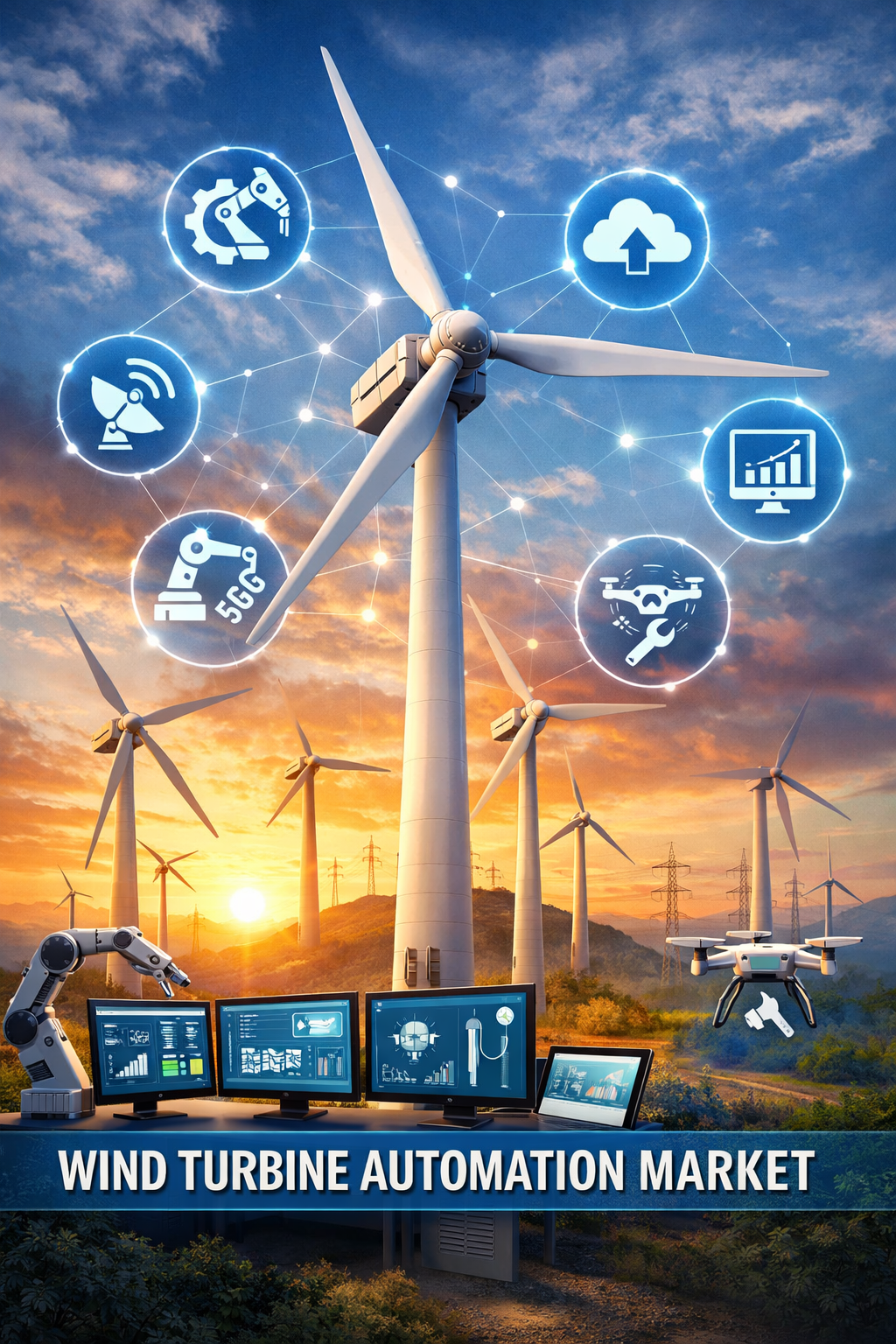
Wind Turbine Automation Market News and Recent Developments
The wind turbine automation market has witnessed significant developments in recent years, driven by strategic collaborations, product innovations, and digital transformation initiatives. Companies are increasingly focusing on integrating advanced analytics and AI-based monitoring systems to enhance turbine efficiency and reduce maintenance costs.
The Wind Turbine Automation Market News and Recent Developments growing adoption of predictive maintenance technologies, partnerships between energy companies and automation providers, and increased investments in offshore wind projects. Recent developments also include the deployment of autonomous inspection drones, digital twins for turbine performance analysis, and advanced SCADA systems for real-time monitoring. These innovations are reshaping the competitive landscape and enabling companies to deliver more efficient and reliable energy solutions.
What Are the Key Drivers Accelerating Market Growth
One of the primary drivers of the wind turbine automation market is the increasing global demand for renewable energy. Governments across the world are implementing favorable policies and incentives to promote clean energy adoption, which is directly boosting the installation of wind turbines. Automation technologies play a crucial role in maximizing energy output and ensuring consistent performance.
Another significant driver is the need to reduce operational and maintenance costs. Automated systems enable predictive maintenance, which helps identify potential issues before they lead to system failures. This reduces downtime and extends the lifespan of wind turbines. Additionally, automation minimizes the need for manual intervention, thereby lowering labor costs and improving safety.
The growing complexity of wind farms, particularly offshore installations, is also driving the adoption of automation solutions. Offshore wind farms require advanced monitoring and control systems due to their remote locations and harsh environmental conditions. Automation ensures efficient operation and real-time data analysis, making it an essential component of modern wind energy projects.
Download Sample PDF Copy@ https://www.theinsightpartners.com/sample/TIPRE00021254
How Are Technological Advancements Shaping the Market Landscape
Technological advancements are playing a transformative role in the wind turbine automation market. The integration of IoT and AI is enabling real-time monitoring and data-driven decision-making. These technologies allow operators to analyze performance metrics, detect anomalies, and optimize energy production.
Digital twin technology is another key innovation that is gaining traction in the market. By creating a virtual replica of a wind turbine, operators can simulate different scenarios and predict performance outcomes. This helps in improving efficiency and reducing operational risks.
Cloud computing and advanced analytics are also contributing to market growth by enabling centralized data management and remote monitoring. These technologies allow operators to access critical information from anywhere, improving operational efficiency and response times.
Furthermore, the adoption of autonomous systems such as drones for inspection and maintenance is reducing the need for manual labor and enhancing safety. These advancements are not only improving operational efficiency but also driving the overall growth of the market.
Segmentation Analysis
The wind turbine automation market can be segmented based on component, application, and end-user.
By component, the market includes hardware, software, and services. Hardware components such as sensors, controllers, and communication systems form the backbone of automation solutions. Software solutions, including SCADA systems and analytics platforms, enable real-time monitoring and data analysis. Services such as maintenance and consulting support the implementation and operation of automated systems.
By application, the market is divided into onshore and offshore wind farms. Onshore wind farms currently dominate the market due to lower installation costs and easier accessibility. However, offshore wind farms are expected to witness higher growth due to their higher energy generation capacity and increasing investments.
By end-user, the market includes utility companies, independent power producers, and industrial users. Utility companies are the largest segment, driven by large-scale wind energy projects and government initiatives.
Top Players in the Market
The wind turbine automation market is highly competitive, with several key players focusing on innovation and strategic partnerships to strengthen their market position. Major companies operating in the market include Siemens Gamesa Renewable Energy, General Electric, ABB Ltd, Schneider Electric, Vestas Wind Systems, Rockwell Automation, Mitsubishi Electric Corporation, Emerson Electric Co., Honeywell International Inc., and Nordex SE.
These companies are investing heavily in research and development to introduce advanced automation solutions. They are also engaging in mergers, acquisitions, and collaborations to expand their global footprint and enhance their product offerings.
Regional Analysis
The wind turbine automation market is geographically diverse, with significant growth opportunities across various regions.
North America is a key market, driven by strong government support and increasing investments in renewable energy projects. The United States is a major contributor, with a growing number of wind farms and advancements in automation technologies.
Europe is another prominent region, with countries such as Germany, the United Kingdom, and Denmark leading the adoption of wind energy. The region's focus on sustainability and carbon reduction is driving the demand for automated wind turbine systems.
Asia Pacific is expected to witness the highest growth during the forecast period. Countries such as China and India are investing heavily in renewable energy infrastructure, creating significant opportunities for market expansion.
The Middle East and Africa, along with South America, are also emerging markets with increasing investments in wind energy projects and growing awareness of renewable energy benefits.
Future Outlook
The future of the wind turbine automation market looks promising, with continuous advancements in technology and increasing investments in renewable energy. The adoption of AI, machine learning, and IoT is expected to drive innovation and improve operational efficiency
About The Insight Partners
The Insight Partners delivers market intelligence and consulting services to help clients make informed decisions. The firm covers industries such as Aerospace and Defense, Automotive and Transportation, Semiconductor and Electronics, Biotechnology, Healthcare IT, Manufacturing, Medical Devices, Technology, Media, and Chemicals and Materials.
Contact Us
Email: sales@theinsightpartners.com
Website: www.theinsightpartners.com
Phone: +1-646-491-9876
Also Available in :

