 English
 Arabic
 French
 Spanish
 Portuguese
 Deutsch
 Turkish
 Dutch
Dutch
 Italiano
 Russian
 Romaian
 Portuguese (Brazil)
 Greek
Greek
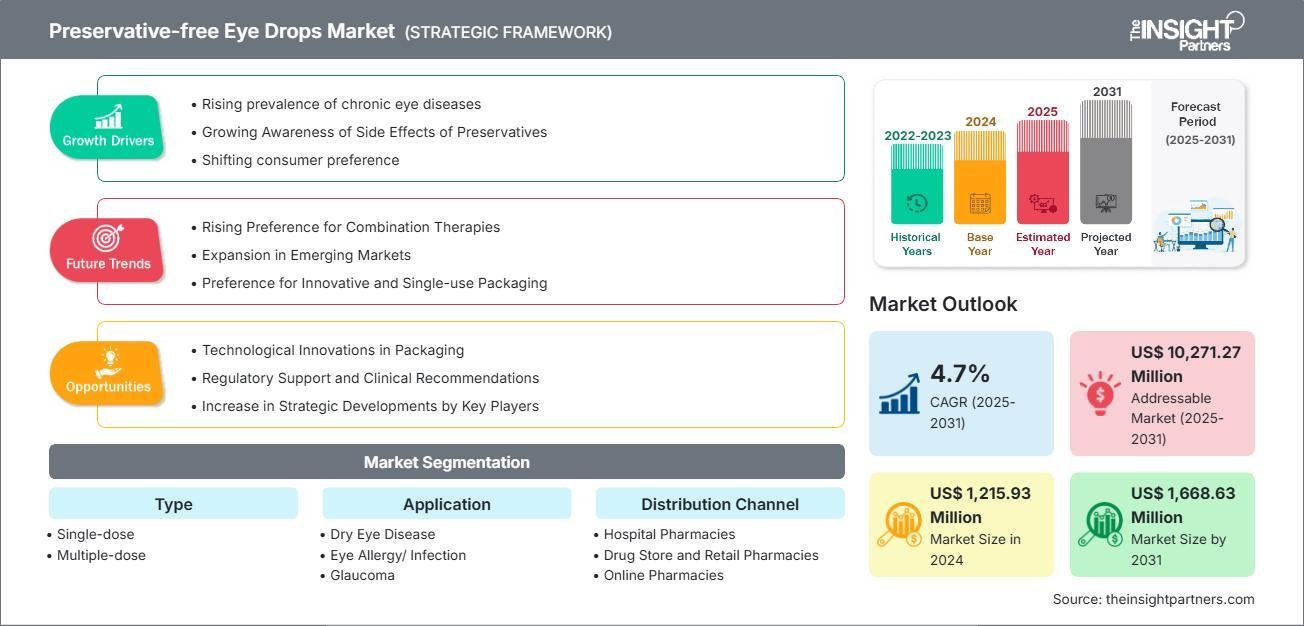
The landscape of ocular health is undergoing a transformative shift as clinicians and patients alike move away from traditional preserved formulations. Historically, the use of chemical preservatives like Benzalkonium Chloride (BAK) was the industry standard to maintain sterility. However, growing clinical evidence linking these additives to corneal damage and chronic irritation has catalyzed a surge in the Preservative-Free Eye Drops Market Growth. This transition is not merely a trend but a fundamental change in how chronic eye conditions are managed.
According to latest industry data, the is on a clear upward trajectory. The market is projected to reach US$ 1.63 billion by 2031 from US$ 1.21 billion in 2024, registering a steady CAGR of 4.7% during the forecast period of 2025 through 2031. This expansion is heavily supported by the increasing volume of geriatric patients who require long-term topical therapies for age-related eye disorders.
Download Sample Report - https://www.theinsightpartners.com/sample/TIPRE00038962
Key Drivers Accelerating Market Expansion
The primary catalyst for the is the rising prevalence of Dry Eye Disease (DED). With the modernization of the workplace and the ubiquitous use of digital screens, "digital eye strain" has become a leading cause of ocular discomfort. Patients suffering from DED often apply lubricants multiple times a day. For these frequent users, preservative-free options are the only way to avoid "preservative toxicity," which can lead to further inflammation and a breakdown of the tear film.
Another major driver is the innovation in Multi-Dose Preservative-Free (MDPF) technology. In the past, preservative-free drops were limited to expensive, single-use plastic vials. Today, advanced bottle designs featuring one-way valves and specialized filters allow users to enjoy the convenience of a standard dropper bottle without the need for chemical stabilizers. This technological breakthrough has significantly lowered the barrier to entry for many consumers, directly contributing to the in the retail and over-the-counter segments.
Strategic Influence of Glaucoma Management
Glaucoma remains a "silent thief of sight" that requires life-long daily medication. Traditional glaucoma drops are often preserved, which can lead to significant ocular surface disease over years of treatment. There is now a strong push from ophthalmic associations to prescribe preservative-free prostaglandins. This shift in medical guidelines is a powerful driver for the as pharmaceutical companies reformulate their blockbuster drugs to meet these new safety standards.
Dominant Market Players
The competitive environment is populated by innovative pharmaceutical firms focusing on delivery systems and patient safety. Key players include:
- Alcon Inc.
- Bausch & Lomb Inc.
- Allergan (AbbVie Inc.)
- Santen Pharmaceutical Co., Ltd.
- Thea Pharma
- Johnson & Johnson Vision Care
- Similasan Corporation
- Ursapharm Arzneimittel GmbH
These organizations are at the forefront of the, investing heavily in R&D to create "smart" dispensers and vitamin-enriched formulas that go beyond simple lubrication to provide active ocular surface repair.
Regional Insights and Future Outlook
While North America currently holds a significant revenue share due to high healthcare spending, the Asia-Pacific region is expected to witness the highest growth rate through 2031. This is due to a combination of an aging population in countries like Japan and China, along with rising awareness of advanced eye care in emerging economies like India.
As the industry moves toward 2031, the will likely be sustained by a "patient-first" approach. With the FDA and other regulatory bodies issuing stricter guidelines on sterility and additive safety, the market is moving toward a future where preservative-free is the default rather than the alternative.
Contact Information -
Email: sales@theinsightpartners.com
Phone: +1-646-491-9876
Also Available in :

